-
Winter – 5.1/10
5.1/10
-
Dry – 8.5/10
8.5/10
-
Wet – 7.3/10
7.3/10
-
Comfort – 8.3/10
8.3/10
-
Treadwear – 8.2/10
8.2/10
Review Summary
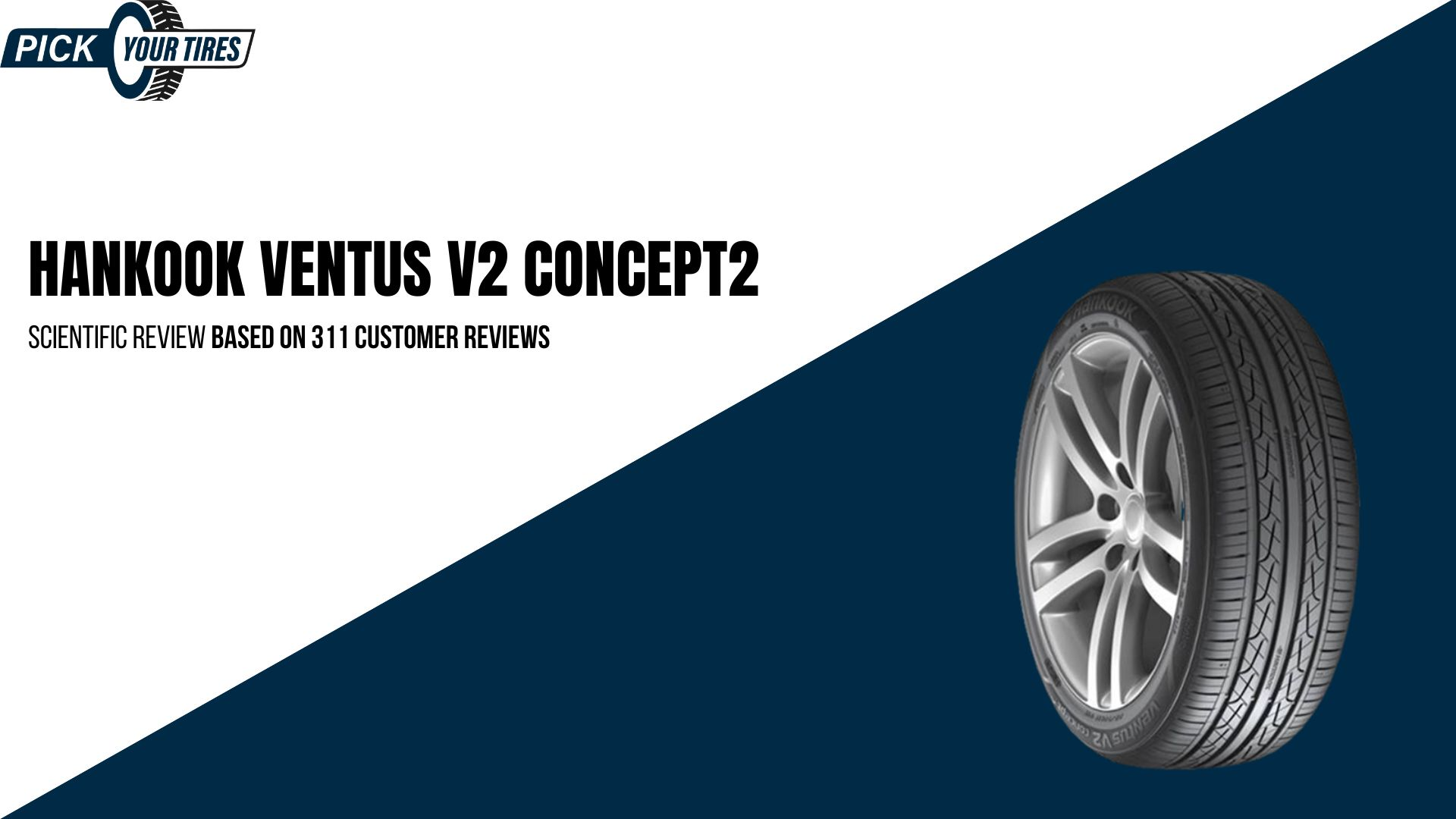
The Hankook Ventus V2 Concept2 got a TireScore rating of 7.5 which is a little bit below the average score of all the all-season tires we have reviewed. It performs pretty well in dry conditions but is a disappointment in snow even taking into consideration that it is an all-season tire. Other strong points of it are the comfort level it provides and the relatively long treadlife.
Pros
- Excellent dry grip and responsive handling
- Smooth, quiet ride for an ultra-high-performance tire
- Long tread life with proper maintenance
- Great value for spirited daily driving
Cons
- Wet performance can degrade as the tire wears
- Poor winter traction in snow and ice
- Some reports of tread or sidewall issues under extreme use
Last Updated on January 3, 2026 by Tom
The Hankook Ventus V2 Concept2 sits inside Hankook’s performance-inspired all-season range, but instead of being pitched as a high-dollar premium tire, it targets buyers who want an affordable way to sharpen their car’s steering while keeping the convenience of year-round use. It’s aimed at sedans, coupes, compact sports cars, and smaller crossovers, with a spread of sizes that makes it one of the more versatile options in its price bracket.
The V2 Concept2 belongs to Hankook’s Ventus line, which has long been the company’s performance arm. While some Ventus models lean heavily toward track-day precision, the V2 Concept2 is tuned for all-season driving. This review blends input from verified customer experiences with shop feedback and published specs, giving a picture of how the tire behaves once it leaves the catalog and meets real roads.
Hankook Ventus V2 Concept2 Main Specs
Category:
High performance all-season
Vehicle type:
Sporty compacts, coupes & sedans
Available sizes:
~15″–20″ (about 195/50R15 to 275/40R20)
Speed rating:
H, V, W (most larger/performance sizes are V or W)
UTQG:
500 AA A (virtually all sizes)
Our Hankook Ventus V2 Concept2 Review is Based on 345 Verified User Reviews.
We believe that our method – collecting real customer reviews from trusted sources, then analyzing them using a combination of manual and AI-supported semi-automatic steps – is the ideal way to produce unbiased reviews.
For all-season tire reviews TireScore is a weighted mix as follows: Dry 25%, Wet 25%, Snow 20%, Comfort & Noise 15% and Treadwear 15%. The result is a number you can trust – based on real world data, analyzed and evaluated with no bias.
Dry Road Behavior
Dry traction is where the Ventus V2 Concept2 makes its strongest case. Owners regularly comment on how predictable it feels in corners, with sidewalls stiff enough to hold a line without rolling over. On winding suburban roads or highway ramps, it carries enough bite that drivers feel confident through everyday turns.
Steering response is often described as quicker than expected at this price point. One Accord owner explained that the tire made the car feel “more eager to change direction,” while a Civic driver described highway lane changes as calmer, with less need for mid-maneuver correction.
Even cars with softer factory suspensions benefit. Compact crossovers that normally lean heavily in corners gain more composure once fitted with the V2 Concept2, giving drivers confidence when traffic flows quickly. It won’t rival a true summer performance tire, but for households that want security and a bit of fun baked into one set, the balance works.
Emergency situations highlight the tire’s strengths. Several reviewers mention controlled stops on dry pavement, even when braking hard from highway speed. That mix of grip and composure is one of the reasons the tire scores so highly in this category.
Tip: If you like this brand but want a model that is slightly better in dry conditions, check out the Hankook Dynapro HP2!
“These tires corner well enough that I left an Alfa Romeo in my dust during my commute this morning. They really transform my Sentra into something fun to drive.”
“I’ve got these on my Camaro, and I drive it hard sometimes. They’re predictable, and I can tell exactly when the limits are approaching. That’s not something I expect from an all-season tire.”
Wet Weather and Rainstorms
In light rain, the V2 Concept2 holds its ground well. The tread grooves clear water efficiently when the tires are new, and drivers in coastal states mention that city intersections and damp suburban roads pose little challenge. Braking distances remain manageable, and the steering wheel communicates enough feedback that drivers don’t feel detached during showers.
The challenges start in heavier rain or once tread depth drops. By the thirty-thousand mile mark, owners begin to notice hydroplaning when crossing pooled water at highway speeds. One Florida commuter described how the first half of tread life felt secure in daily downpours, but after wear set in, the car began to feel lighter on the wheel during summer storms.
Shops confirm this trend, pointing out that skipped rotations accelerate the decline. Hydroplaning resistance is directly tied to tread depth, so once the channels lose volume, water has fewer escape routes.
For most regions with occasional rain, the tire remains serviceable. But in areas with tropical weather or frequent downpours, households often look to alternatives with stronger reputations for wet grip.
“I’ve driven over 100 mph in the rain on other tires without issue, but with these, anything over 65 feels sketchy when the roads are wet.”
Winter and Cold Conditions
Winter traction is one of the Ventus V2 Concept2’s weakest points. Drivers in warmer states often manage light snow or frost without major problems, thanks to siping across the tread blocks that helps at low speeds. A Virginia owner explained that his sedan could get through dustings as long as traffic had smoothed the surface first.
In harsher climates, however, the limits appear quickly. Drivers in Michigan and Minnesota mention long braking distances on packed snow and spin when starting from stoplights. Owners in Vermont often park the V2 Concept2 once winter sets in, switching to dedicated snow tires because icy backroads overwhelm the compound.
There are occasional reports of the tire handling storms with more composure than expected, usually credited to careful driving. But most shops classify it as a three-season option. It can cover mild winters, yet deeper snow and prolonged ice are well beyond its reach.
Tip: In case you’re looking for an all-season tire that performs much better in snow, check out our review of the Michelin Defender LTX M/S!
“These are appalling in any kind of snow or icy conditions. I checked multiple times to make sure they weren’t summer tires. They spin going up my driveway unless it’s completely cleared.”
“I’m using these on my Mini Clubman in Connecticut. Light snow isn’t a problem if you adjust your speed, but when it gets icy or slushy, you’re better off switching to winter tires.”
Comfort and Cabin Noise
The Ventus V2 Concept2 doesn’t ride as stiff as its sporty image suggests. Commuters say rough pavement feels less punishing than expected, with expansion joints and shallow potholes softened enough that the cabin doesn’t take a jolt. Families running crossovers often call out the same thing after long trips, noting how the ride feels calm even after hours on the road.
Noise tends to stay in check through the early life of the tire. On smooth asphalt it blends into the background, leaving the car’s own mechanical sounds to stand out. Once mileage stacks past twenty thousand, some drivers mention a firmer hum starting to creep in at highway speeds, more noticeable in smaller cars with thin insulation than in larger sedans.
For long-distance travel, many owners describe the ride as calm and quiet enough to make hours on the interstate manageable. That blend of feedback and comfort is what sets the V2 Concept2 apart from cheaper all-seasons that sacrifice one for the other.
❞
“These tires made my car quieter than stock, even though the factory tires had foam inserts. I’m running 18-inch wheels instead of the OEM 20s, and the ride is smoother too.”
Wear and Longevity
Longevity earns steady praise from drivers. Many report between twenty and forty thousand miles before considering replacements, which is strong for a tire that carries sporty handling traits. Sedans and smaller crossovers rotated every five to six thousand miles often reach the higher end of that range.
There are scattered complaints of tread or sidewall issues, but these tend to come from aggressive driving or heavier vehicles. Some owners using the tire on sports coupes during spirited runs note faster wear at the shoulders. A few cases of separation appear in reports tied to track use, which is outside the intended design.
EVs and heavier SUVs can chew through the compound faster due to torque and weight. Still, most households driving steady routes with proper maintenance find the tire’s lifespan matches or exceeds expectations in its class.
Tip: One of the best all-season tires when it comes to longevity is the Continental TrueContact Tour!
“I’m on my second set of these tires. The first lasted over 30,000 miles with lots of spirited driving, and they still had tread left.”
“I’ve used these on multiple cars. Even after 15,000 miles of hard use, they still look great and have plenty of tread.”
Who This Tire Suits Best
The Hankook Ventus V2 Concept2 fits households that want sharper steering and stronger grip than a basic touring design, without the hassle or cost of switching between seasonal sets. Drivers of lighter sedans and coupes often notice the quicker steering first, while small crossovers still pick up enough response to feel more connected on daily routes.
In areas where winters stay mild, the tire manages dry pavement and damp roads reliably, giving households a mix of steady handling and fair pricing that keeps it practical. Commuters often highlight its predictability, while families mention the quiet ride as a reason they’d buy it again.
It is less suited to drivers in rain-heavy states or snowbelt regions. Wet traction fades as tread depth falls, and winter coverage is minimal beyond light snow. Households in those areas often pair it with cautious habits or keep a separate winter set.
Final Notes and Warranty
Hankook lists mileage coverage that can reach up to forty thousand miles, depending on the tire’s size and rating. Shops often remind buyers that coverage isn’t automatic, and service logs make the difference. Keeping records of rotations and pressure checks gives drivers a stronger case if tread life falls short of the advertised mark.
The compromises are straightforward. Dry grip is strong, comfort and noise control exceed expectations, and tread life is respectable for the price. Wet grip declines with wear, and winter behavior is limited. That mix makes it a practical three-season option.
For households looking to stretch their budget while still wanting a tire that feels alive at the wheel, the Ventus V2 Concept2 has a place. It isn’t sold as a summer-only product, and it won’t behave like one, but it carries enough grip and comfort that weekday commutes, weekend errands, and longer drives feel steady without turning into a chore.
Is the Hankook Ventus V2 Concept2 good in snow?
It isn’t even for an all-season tire.
Is the Hankook Ventus V2 Concept2 a quiet, comfortable tire?
Yes, it’s designed with noise-control tread features and most drivers find it pleasantly quiet and comfortable for daily use.
How long does the Hankook Ventus V2 Concept2 last?
It comes with a 45,000-mile treadwear warranty, and real-world reviews generally report good tread life for the price.
How does the Hankook Ventus V2 Concept2 perform in rain?
Wet traction is generally solid thanks to its silica compound and V-shaped grooves, though there are better all-season alternatives out there.