-
Winter – 6.6/10
6.6/10
-
Dry – 9/10
9/10
-
Wet – 8.2/10
8.2/10
-
Comfort – 8.3/10
8.3/10
-
Treadwear – 8.3/10
8.3/10
Review Summary
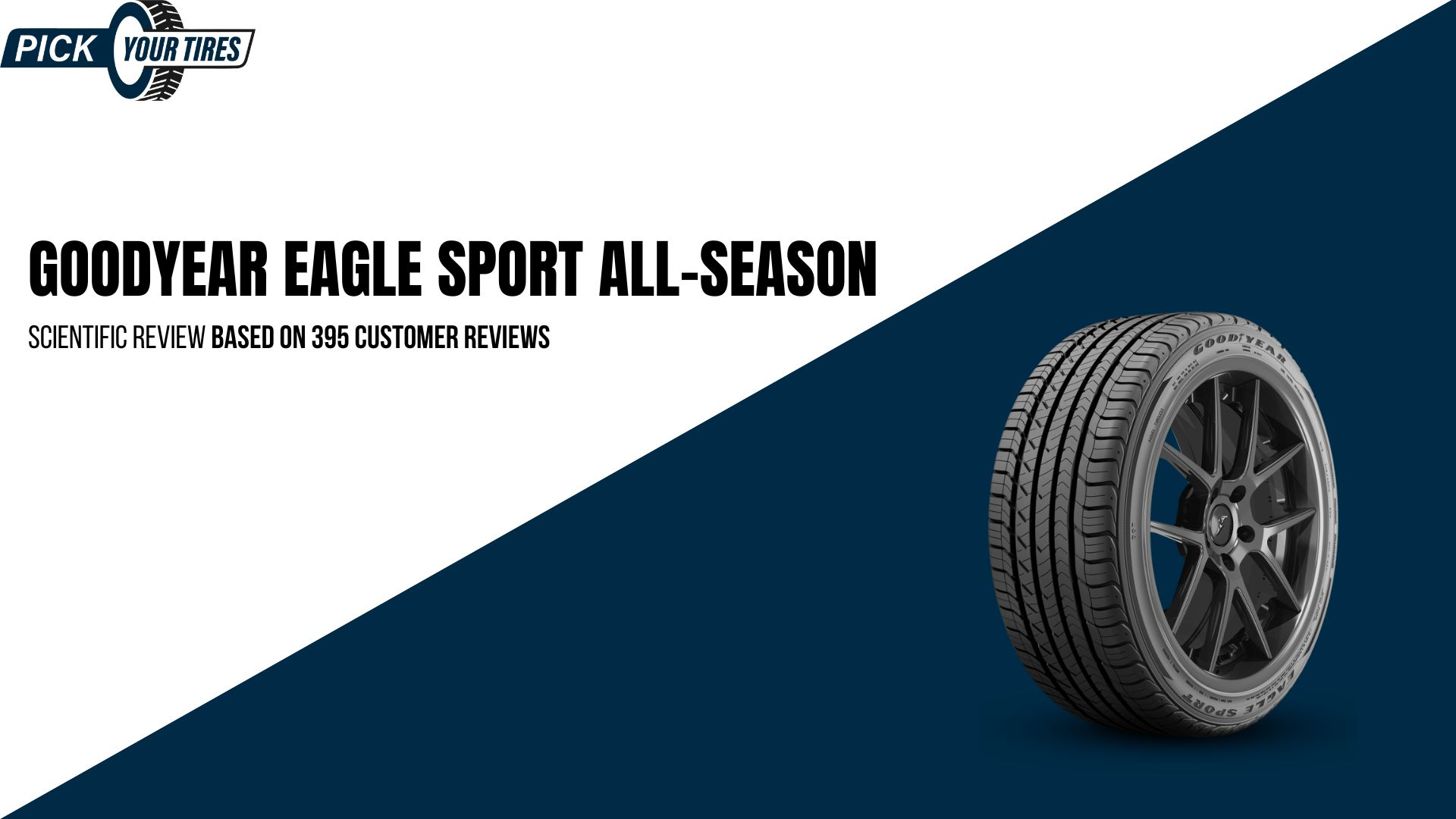
The Goodyear Eagle Sport All-Season got a TireScore rating of 8.1 which is just around the average score of all the all-season tires we have reviewed. It excels in dry conditions but it may let drivers down when it comes to snowy or icy conditions. If you live in a region where you experience light snow from time to time, you should look for an all-weather tire or an all-season one that is more capable in those conditions.
Pros
- Outstanding dry traction and responsive handling
- Predictable performance at the limits
- Good tread life for a performance all-season tire
- Rim protector feature adds curb safety
Cons
- Poor snow and ice performance
- Road noise increases with wear, especially on rough pavement
- Some reports of foam detachment in EV versions
- Wet handling can be unpredictable at highway speeds
Last Updated on January 3, 2026 by Tom
The Eagle Sport All-Season is Goodyear’s entry in the performance-oriented all-season space. It’s pitched at drivers who want sharper steering than a touring model provides but still need a tire they can leave on year-round. Goodyear offers it in a broad range of sizes, covering sedans, coupes, crossovers, and some SUVs. The design leans on a tread pattern built for stability in dry conditions, wide grooves for rain, and enough siping to handle short spells of winter weather.
This review draws from driver reports, shop observations, and published specs to piece together how the Eagle Sport All-Season behaves once it leaves the showroom. The focus is on real-world behavior: how it tracks through city traffic, what happens when the road gets wet, and how the tread looks after tens of thousands of miles.
Goodyear Eagle Sport All-Season Main Specs
Category:
Ultra high-performance all-season (UHP) passenger tire
Vehicle type:
Sports cars, coupes, sedans, plus some performance-oriented CUVs/SUVs and light trucks
Available sizes:
Roughly 16″ up to 22″ rim diameters (e.g. 205/55R16 up to 285/45R22, depending on market and fitment
Speed rating:
Mix of H, V, and W, varying by size (many performance fitments are V or W)
UTQG:
400 AA – 560 AA depending on size
Our Goodyear Eagle Sport All-Season Review is Based on 425 Verified User Reviews.
We believe that our method – collecting real customer reviews from trusted sources, then analyzing them using a combination of manual and AI-supported semi-automatic steps – is the ideal way to produce unbiased reviews.
For all-season tire reviews TireScore is a weighted mix as follows: Dry 25%, Wet 25%, Snow 20%, Comfort & Noise 15% and Treadwear 15%. The result is a number you can trust – based on real world data, analyzed and evaluated with no bias.
Dry Roads and Steering Feel
On dry pavement, most drivers say the tire feels secure, almost like a summer set. Steering comes through clearly without feeling twitchy, so lane changes happen with little correction. Highway commuters talk about how the tire stays centered at speed, tracking calmly through concrete sections that make softer tires wander.
One owner of a midsize sedan described his first week on the Eagle Sport All-Season as “finally being able to point the car where I wanted, instead of waiting for the tires to catch up.” Smaller coupes echo similar notes, often praising the way the shoulders grip through routine corners without roll or lean.
Aggressive driving changes the story. Enthusiasts pushing through backroads report understeer as limits approach, the kind of slip that shows up before a summer tire would. Still, for everyday use, the stability at freeway speeds and predictable steering in traffic get mentioned more often than the limits under heavy cornering.
Very grippy tires with my style of driving. I push the limits sometimes, and these tires definitely outperform the OEM tires.”
“The Eagles are everything you’d want for a summer tire, but with the bonus of all-season capability. Stable when cornered hard and still comfortable on the highway.”
Wet Roads and Standing Water
In light to moderate rain, grip holds up well. Drivers talk about smooth braking at intersections and the way the grooves clear surface water. Shop techs add that during the first half of tread life, hydroplaning complaints are rare.
Once storms get heavier, results split. Some drivers say the tire still feels planted, while others mention the wheel going light when crossing deeper puddles at highway speed. A commuter in Florida said his sedan handled afternoon downpours fine at city pace, but admitted the car felt unsettled on the interstate once lanes began pooling near barriers.
That shift often happens after the tread wears down. By the thirty-thousand mark, hydroplaning resistance isn’t as strong, especially if rotations were skipped. For most households the wet grip is good enough for daily use, but in areas with frequent heavy rainstorms, cautious driving habits become part of the routine.
Tip: If you are looking for an all-season tire that is reported by users to perform very well in wet conditions, check out our Michelin Crossclimate 2 review.
They’re okay in drizzle, but in real rain, especially on the highway, they feel like they want to hydroplane at any moment.”
Snow and Cold Weather
Snow coverage depends on where the tire is used. In states where plows clear quickly and storms don’t last long, the Eagle Sport All-Season gets by. Drivers in Virginia and Ohio say they’ve managed frosty mornings without major slip, helped by the siping that gives the tread some bite on thin snow.
In harsher climates, the limitations stand out. Michigan drivers mention long braking distances on packed snow and spin when pulling away from stoplights. Vermont owners often switch to dedicated winter tires once December arrives, knowing that deeper snow and icy backroads push the compound past its limit.
Still, there are anecdotes where the tire outperformed expectations. A Colorado coupe owner described handling an early-season storm with surprising composure, though he credited careful throttle more than the tire itself. Shops generally treat the Eagle Sport All-Season as a three-season option: fine for light snow, not suited for deeper winter coverage.
Pro tip: The Michelin Defender 2 seems to be a much better all-season tire for snowy roads.
“Absolutely dangerous in snow. The traction in two inches of snow was scary.”
“I’ve had to get off the highway when it snowed because these tires just couldn’t handle it.”
Ride Comfort and Noise
When new, comfort is one of the tire’s stronger points. Raised expansion joints don’t jolt the cabin, and smaller potholes get muted. Drivers switching from worn factory sets often describe the first few weeks as smoother than expected from a performance-oriented tire.
Noise is more complicated. On fresh asphalt the tread fades into the background, letting cabin sounds take over. By twenty thousand miles, though, several drivers note a sharper tone creeping in at speeds above sixty. Compact cars with little insulation hear it more clearly, while larger sedans and crossovers keep it muffled.
EV owners raise their own concern. Some report that the noise-reducing foam inside the tire detaches before the tread wears out, creating vibration and extra cabin noise. For gas sedans and crossovers, that issue is rare, but it’s a reminder that this tire isn’t always the quietest once mileage stacks up.
❞
“At first, these tires were quiet and smooth. But at around 6,000 miles, I noticed the insulation came apart inside one of the tires. The car started to vibrate badly.”
Wear and Longevity
Feedback on tread life ranges widely. Plenty of owners say the tire runs close to warranty expectations with routine care. Sedans and crossovers rotated every five to six thousand miles often show even wear, holding grip well into the forty-thousand range.
Others see quicker fade. Aggressive cornering and heavy vehicles shorten lifespan, with some reports of tread dropping near half depth by twenty thousand miles. Shops point out that under-inflation and missed rotations are usually behind those results.
Electric vehicles and heavier SUVs add more strain. Torque and weight chew into the shoulders, and some drivers report uneven wear showing by mid-life. On the other hand, commuters driving steady weekly routes often stretch mileage further, approaching fifty thousand before replacement.
The variation highlights a pattern: routine care keeps the tire in line with expectations, while skipped service or hard driving shortens its usable life considerably.
“I put over 50,000 miles on them and still had usable tread left. Honestly, I didn’t expect them to last that long, especially on a heavy hybrid SUV.”
The noise-reducing foam came apart in two sets of tires in less than 5,000 miles.”
Where It Fits Best
The Eagle Sport All-Season fits households that want sportier steering and stronger grip than a touring tire but don’t want the hassle of seasonal swaps. Drivers of sedans and coupes see the biggest benefit, since the sharper steering shows up most clearly in lighter cars. Families running smaller crossovers note that it keeps traction in the rain and stays quiet enough for errands, which makes it a practical option for mixed driving.
In coastal states, wet grip is the main appeal. In the Midwest, balance between ride comfort and dry stability makes it a common commuter choice. In snowbelt regions, many still swap to winter tires once storms arrive, using the Eagle Sport All-Season as their warmer-weather set.
Warranty and Final Notes
Goodyear lists mileage coverage that tops out around fifty thousand miles, depending on size and rating. Shops remind customers that warranty claims almost always require proof of rotations and inflation checks, so keeping service records matters.
The compromises are clear. Dry grip is strong enough for daily use but not equal to a summer set in sharp cornering. Wet traction works in lighter rain, but hydroplaning becomes a risk as tread depth falls.
Snow coverage stops short of what’s needed in deep winter, which means it’s best viewed as a three-season option in harsher climates. The Eagle Sport All-Season hits a middle ground that blends sporty feel with daily practicality.
Is the Goodyear Eagle Sport All-Season good in snow?
It does fine in light snow, with decent traction and stability for an all-season UHP tire, but it struggles more on ice and in deep snow. If you regularly drive in harsh winters, a dedicated winter tire will be safer and more confidence-inspiring.
How long do Goodyear Eagle Sport All-Season tires last?
Most fitments come with a 50,000-mile treadwear warranty (around 80,000 km), though rear tires on staggered setups are typically covered to 25,000 miles. Real-world owners often report solid tread life for a performance-oriented tire, assuming proper alignment and rotation.
Are Goodyear Eagle Sport All-Season tires noisy?
Survey data and owner reviews rate ride quality and noise as “good” overall, but a noticeable minority of drivers mention road noise as a downside.