-
Winter – 8.4/10
8.4/10
-
Dry – 9.3/10
9.3/10
-
Wet – 9.3/10
9.3/10
-
Comfort – 8.7/10
8.7/10
-
Treadwear – 9.1/10
9.1/10
Review Summary
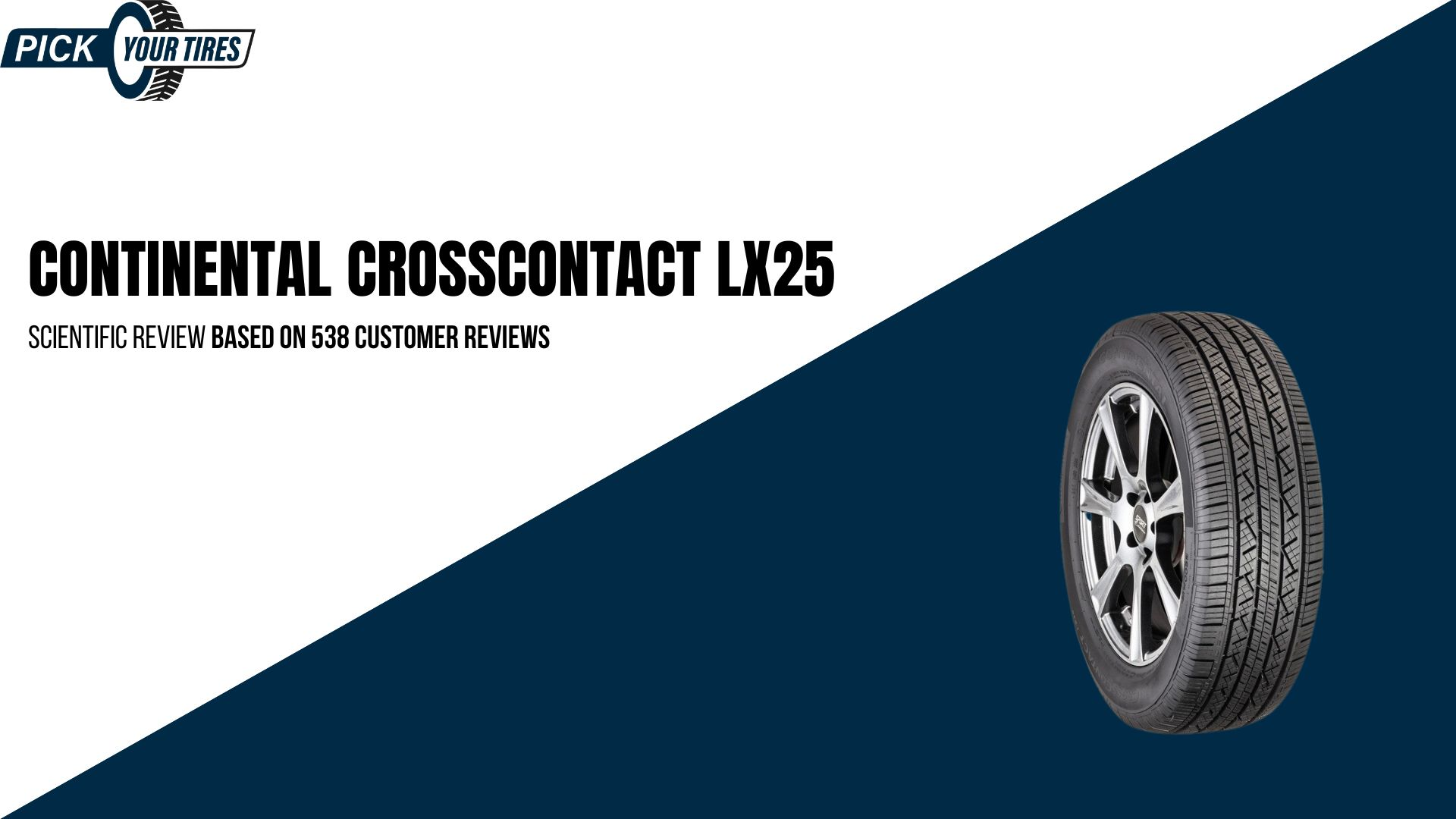
The Continental CrossContact LX25 got a TireScore rating of 9.0 which is one of the best amongst all the all-season tires we have reviewed. It performs exceptionally well in every condition, offers great comfort and is very durable as well.
Pros
- Outstanding dry and wet traction
- Very good performance in snow compared to most all-season tires
- Great durability
- High level of comfort and low noise
Cons
- Relatively high price tag
Last Updated on January 24, 2026 by Tom
The Continental CrossContact LX25 comes as a factory-fitted OEM model on crossovers and SUVs, and it’s such a fan favorite for drivers that many choose to stick with it when it’s time for a replacement set. Offering years of predictability and reliability in routine driving conditions, the CrossContact LX25 feels settled on familiar routes around town, and on the highway.
Reviews on the LX25 show drivers commenting on how the steering tracks straight, braking response feels consistent, and as mileage builds during normal commutes, subtle changes in cabin noise start to shape impressions on the tire and it benefits for long-term ownership.
This review brings you real-world data on the CrossContact LX25 and how it behaves in all road conditions.
Continental CrossContact LX25 Main Specs
Category:
Crossover/SUV touring all-season
Vehicle type:
SUVs, crossovers, light trucks (and some vans)
Available sizes:
~16″–20″
Speed rating:
Mix of T, H, V (varies by size)
UTQG:
~700 A A – 740 A A/B (varies by size)
The CrossContact LX25 shows up most often on SUVs and crossovers that live their lives on tar, parked in driveways overnight, loaded with bags or kids during the day, then pointed down familiar roads again the next morning. The casing keeps its shape when the vehicle’s carrying weight, and the tread keeps its footing as the surface shifts from smooth asphalt to patched sections that have seen a few summers.
EcoPlus Technology works in the background, showing up over time rather than all at once. Fuel use tends to hold its pattern as the tread wears, which drivers usually notice when fill-ups stay familiar week after week. Beneath the tread, the Comfort Ride construction takes the edge off rough pavement before it reaches the suspension, most noticeable when crossing expansion joints or worn city lanes where vibrations normally sneak through.
Wet roads bring the tread design into focus. Wide circumferential channels keep water moving away as the tire ages, helping contact stay predictable during steady rain. Continental puts a 70,000 mile treadwear figure on the LX25, and most drivers don’t treat it like a finish line. Tread depth usually gets checked during oil changes or brake work, fingers brushing the grooves, with the real decision happening later when wear becomes obvious.
Our Continental CrossContact LX25 Review is Based on 538 Verified User Reviews.
We believe that our method – collecting real customer reviews from trusted sources, then analyzing them using a combination of manual and AI-supported semi-automatic steps – is the ideal way to produce unbiased reviews.
For all-season tire reviews TireScore is a weighted mix as follows: Dry 25%, Wet 25%, Snow 20%, Comfort & Noise 15% and Treadwear 15%. The result is a number you can trust – based on real world data, analyzed and evaluated with no bias.
Owners often describe the LX25 as smooth early and predictable once it settles in. Steering stays steady, braking remains controlled, and wet-road confidence holds through seasonal driving. It does what it’s expected to do without demanding attention.
Noise becomes part of the conversation later. Many drivers first notice a change somewhere past the 10,000-mile mark, often on concrete highways or rougher asphalt. A few mention a mild wandering sensation on patterned pavement, which shops usually trace back to wear patterns or alignment drift.
Most replacements happen because of mileage and age rather than sudden issues. Service records point to even wear when rotation schedules are followed.
Dry Performance Score: 9.3 / 10
On dry pavement, the LX25 tracks straight through daily traffic and longer highway drives. Steering input feels consistent around center, and the tire holds its lane unless alignment has already shifted. City turns feel controlled, and braking remains even through full stops.
At highway speed, lane changes stay composed. The tread holds shape during long curves, and vibration stays out of the wheel unless suspension components are already wearing. As mileage builds, steering feel softens slightly, something drivers tend to notice on sweepers rather than sharp turns.
Grip remains present, though feedback changes as the finer tread elements wear down. Surface texture becomes more noticeable through the wheel, especially on vehicles with older suspension parts.
“Cornering and wet traction is superb. Dry traction is above average.” — 2022 Mazda CX-30 AWD Owner
“The main reason I bought these was for comfort and noise, but I’ve been very happy with the cornering grip as well.” — 2016 Toyota Tacoma Owner
Wet Performance Score: 9.3 / 10
Wet-road behavior stays consistent through much of the LX25’s life. Water clears effectively when tread depth remains above mid-range, and braking stays controlled during steady rain. Acceleration from a stop holds on wet pavement, particularly on front-wheel and all-wheel drive platforms.
Drivers in rain-heavy regions often mention stable highway tracking during storms. Shallow pooling doesn’t disrupt steering, and the tire stays settled at cruising speed. As tread depth drops, braking distances lengthen slightly on slick surfaces, though the change comes on gradually.
Loss of grip usually ties back to worn tread or pressure drift rather than appearing suddenly. With routine maintenance, wet-road behavior remains familiar even as miles add up.
“Our southern roads get lots of grooves and puddles, but this tire is extremely confident through shallow and deep puddles.” — Jasper, TX Driver
Winter & Snow Traction Score: 8.4 / 10
A light snow cover or shallow slush changes the launch. The LX25 brings the car off the line in a measured roll rather than a quick jump. The tread finds enough bite to roll forward cleanly, and braking brings the car down in a straight path, with stopping distances stretching as speeds rise beyond neighborhood limits.
Packed snow changes how the tire behaves. Pulling away on an incline takes time, and the front tires may rotate briefly before settling into grip. Vehicles with AWD hold momentum longer, though ice cuts that margin quickly, especially once the tread has seen extended use and the siping begins to shallow.
Cold days broken up by dry pavement don’t introduce new behavior. Movement stays deliberate. Speed builds at a slower rate, stopping takes more room, and steering angles don’t change from the lines the driver already knows.
“These are outstanding for light and even moderate snow, excellent wet traction and hydroplane avoidance.” — Ashburn, VA Driver
“In 6 inches of Ohio snow, these tires pulled my AWD vehicle through with no issues.” — Glenside, PA Driver
Comfort & Noise Score: 8.7 / 10
Ride comfort shows itself early and keeps showing up during ordinary use. Speed bumps, patched asphalt, and expansion joints register as rounded movements through the seat and steering wheel. On city streets, the tire absorbs surface texture before it reaches the suspension, and highway stretches carry that same settled feel once speeds level out.
Noise develops in a slower, more noticeable way. Fresh sets stay restrained at cruising speed. As mileage passes the five figure mark, a steady hum begins to appear on concrete sections and coarse asphalt, especially during longer drives when the cabin stays quiet. The sound stays present once it arrives, following road texture rather than traffic speed.
❞
“Out on the concrete interstate, this tire is super quiet. It is pretty quiet on nicely paved asphalt, too.” — Wisconsin Driver
Treadwear & Longevity Score: 9.1 / 10
Wear patterns on the LX25 stay even when rotation schedules are followed. Drivers rotating on time often report uniform tread depth well past 40,000 miles. Shoulder wear and cupping usually appear when alignment drifts or rotations are missed.
EcoPlus Technology appears to slow tread wear rather than eliminate it. Many owners reach higher mileage without sharp changes in handling or braking. Sidewall durability holds under normal use, and failure reports remain uncommon in service records.
“Have 61K miles, easily another 5,000 left. Will certainly reorder.” — Woodstock, CT Driver
“I have used Michelin, Pirelli, and others, but this tire has become my ‘go-to’ for years because of good quality and price point.” — Duluth, MN Driver
Who Is This Tire For?
The CrossContact LX25 ends up under drivers who spend most of their time on paved roads and want a ride that stays comfortable as miles add up. It fits daily commuting, family use, and long highway drives where consistency matters more than sharp response.
Drivers in rain-prone regions benefit from steady wet-road behavior. Those in mild winter areas get usable cold-weather traction without frequent seasonal changes. In harsher winter zones, switching to winter tires remains common.
Noise awareness becomes part of ownership as mileage builds. Maintenance plays a role in how long the tire keeps its original feel. For everyday SUV and crossover driving, the LX25 delivers steady performance that rarely draws attention, which is why many drivers return to it when replacement time comes around.
How long do Continental CrossContact LX25 tires last?
They’re backed by 70,000 miles (T/H) or 65,000 miles (V), and regular rotations/alignment matter a lot.
Are CrossContact LX25 tires good in snow?
Generally good in light/moderate snow for an all-season, but ice traction still needs caution.
How do they do in rain / hydroplaning?
Wet traction is a highlight, with strong grip and hydroplaning resistance in reviews and surveys.